



Aldose Reductase
AKR1B1; Aldo-keto reductase family 1 member B
Aldose reductase is a small, cytosolic, monomeric enzyme which belongs to the aldo-keto reductase superfamily. Aldose reductase catalyzes the reduced form of nicotinamide adenine dinucleotide phosphate (NADPH)-dependent reduction of a wide variety of aromatic and aliphatic carbonyl compounds. It is implicated in the development of diabetic and galactosemic complications involving the lens, retina, nerves, and kidney.
Aldose reductase is both the key enzyme of the polyol pathway, whose activation under hyperglycemic conditions leads to the development of chronic diabetic complications, and the crucial promoter of inflammatory and cytotoxic conditions, even under a normoglycemic status. Aldose reductase represents an excellent drug target and a huge effort is being done to disclose novel compounds able to inhibit it.
All Product Categories
-
Aldose Reductase Related Products (134)
Related Products (134)

-
Antibodies (2)
-
ARI-809
 0 ImagesCat. No.: HY-119058CAS No.: 463976-07-0Synonyms: CP-744809ARI-809 (CP-744809) is a highly selective, orally active aldose reductase inhibitor with an IC50 of 1 nM. ARI-809 blocks excessive glucose flux through the polyol pathway. ARI-809 normalizes elevated sorbitol and fructose levels in sciatic nerve tissues of diabetic rat models, inhibits sorbitol accumulation in lens tissues, and brings elevated urinary albumin excretion close to normal. ARI-809 can be used in diabetes research.
-
Aldose reductase-IN-6
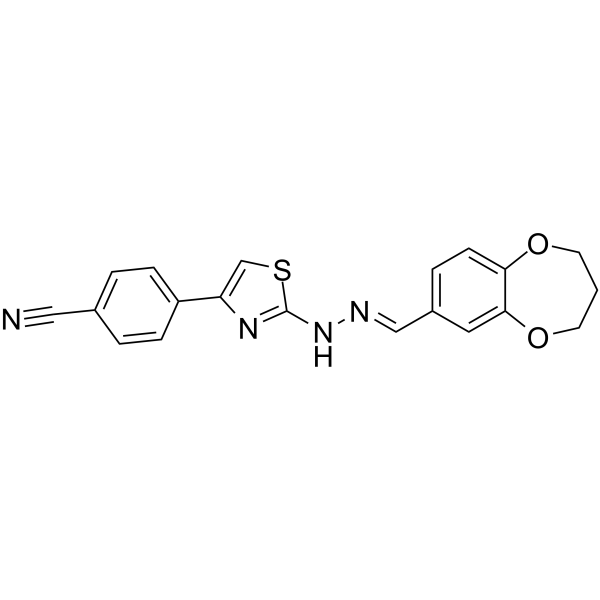 0 ImagesCat. No.: HY-147875CAS No.: 2470019-41-9Aldose reductase-IN-6 (Compound 3) is a competitive aldose reductase (AR) inhibitor with an IC50 of 3.164 μM and a Ki of 0.018 μM. Aldose reductase-IN-6 exhibits no cytotoxicity against healthy cells.
-
SG-210
 0 ImagesCat. No.: HY-106915CAS No.: 143162-65-6Synonyms: SPR 210SG-210 (SPR 210) is an orally active and selective aldose reductase (AR) inhibitor. SG-210 has IC50 values of 9.5 nM and 10 nM for AR from porcine lens and human placenta, respectively. SG-210 can inhibit sorbitol accumulation and ameliorate diabetic neuropathy and retinopathy in Streptozotocin (HY-13753)-induced diabetic rats. SG-210 can be used in the research of diseases such as diabetes-related complications.
-
Aldose reductase-IN-9
 0 ImagesCat. No.: HY-175854Aldose reductase-IN-9 (Compound 8b) is an Aldose reductase (ALR2) inhibitor with a Ki value of 3.59 nM. Aldose reductase-IN-9 has anti-tumor activity.
-
ALR2-IN-10
 0 ImagesCat. No.: HY-W283860CAS No.: 135-64-8ALR2-IN-10 (Compound 23) is a weak Aldose Reductase 2 inhibitor with inhibition rate of 6% at 27 μM. ALR2-IN-10 can be used for the research of diabetic complication.
-
Corybulbine
 0 ImagesCorybulbine, an alkaloid that can be isolated from the methanolic extract of Corydalis ternata, is an aldose reductase (ALR2) inhibitor. Corybulbine can be used for diabetic complications research.
-
AD-5467
 0 ImagesCat. No.: HY-117339CAS No.: 112808-22-7AD-5467 is a potent and selective aldose reductase inhibitor. AD-5467 exhibits antidiabetic effect. AD-5467 can be used for the research of metabolic disease, such as diabetes.
-
AKR1C3-IN-17
 0 ImagesCat. No.: HY-187527CAS No.: 3120497-79-9AKR1C3-IN-17 is a cathepsin B (CTSB)-activated small molecule-drug conjugate targeting AKR1C3 with an IC50 of 9 nM. AKR1C3-IN-17 is cleaved by CTSB to release the payload Gemcitabine (HY-17026). AKR1C3-IN-17 induces apoptosis and shows antitumor activity in mice. AKR1C3-IN-17 can be used for the study of hepatocellular carcinoma.
-
Poliumoside (Standard)
 0 ImagesPoliumoside (Standard) is the analytical standard of Poliumoside. This product is intended for research and analytical applications. Poliumoside, a caffeoylated phenylpropanoid glycoside, is isolated from Brandisia hancei stems and leaves. Poliumoside is an advanced glycation end product (AGE) formation and rat lens aldose reductase (RLAR) inhibitor, with IC50s of 19.69 and 8.47 μM, respectively. Poliumoside also has antiinflammatory and antioxidant activity.
-
Salfredin A3
 0 ImagesCat. No.: HY-N14447CAS No.: 139542-53-3Salfredin A3 is an aldose reductase inhibitor.
-
Salfredin C2
 0 ImagesCat. No.: HY-N14431CAS No.: 139542-57-7Salfredin C2 is an aldose reductase inhibitor.
-
Salfredin C1
 0 ImagesCat. No.: HY-N14451CAS No.: 139542-56-6Salfredin C1 is an aldose reductase inhibitor.
-
Sorbinil (Standard)
 0 ImagesSorbinil (Standard) is the analytical standard of Sorbinil. This product is intended for research and analytical applications. Sorbinil is an aldose reductase inhibitor (ARI) that prevents the accumulation of sorbitol in cells or animals. Sorbinil is useful in studying diabetes and diabetic complications, reducing AR activity and inhibiting the polyol pathway.
-
Quercetin 3-gentiobioside (Standard)
 0 ImagesQuercetin 3-gentiobioside (Standard) is the analytical standard of Quercetin 3-gentiobioside (HY-N4089). This product is intended for research and analytical applications. Quercetin 3-gentiobioside is a flavonoid found in Artemisia iwayomogi. Quercetin 3-gentiobioside inhibits aromatase with an Ki of 46.77 nM. Quercetin 3-gentiobioside inhibits aldose reductase (AR) and the formation of advanced glycation end products (AGEs), with IC50 values of 10.60 μM and 109.46 μM, respectively. Quercetin 3-gentiobioside inhibits proliferation of cancer cells and fibroblast-like synoviocytes. Quercetin 3-gentiobioside can be used for the research of cancer, such as lung carcinoma.
-
ALR2-IN-9
 0 ImagesCat. No.: HY-175862CAS No.: 2135481-84-2ALR2-IN-9 is a potent ALR2 inhibitor (IC50 = 21.8 nM) with excellent antioxidant activity (EC50 for DPPH radical scavenging = 2.8 μM). ALR2-IN-9 interacts directly with Reactive Oxygen Species (ROS)/Reactive Nitrogen Species (RNS) and interrupts the free radical chain reactions, and as an endogenous enzymatic antioxidant regulator, which regulates enzyme functions of CAT and SOD. ALR2-IN-9 regulates PI3K/Akt/Nrf2 pathway to attenuate hyperglycemia-mediated mitochondrial superoxide overproduction in vitro, and ameliorates CuSO4- and H2O2-induced oxidative stress in vivo. ALR2-IN-9 prolongs lifespan of C. elegans via the regulation of stress response genes such as PMK-1. ALR2-IN-9 is a promising anti-aging drug candidate. ALR2-IN-9 can be used for diabetic complication research.
-
SX 3202
 0 ImagesCat. No.: HY-183923CAS No.: 147254-65-7SX 3202 is an aldose reductase inhibitor. SX 3202 can be used for the research of diabetic complications.
-
3,4,6-Tribromo-5-methylbenzene-1,2-diol
 0 ImagesCat. No.: HY-184036CAS No.: 56759-56-93,4,6-Tribromo-5-methylbenzene-1,2-diol (Compound 4) acts as an aldose reductase inhibitor with an IC50 of 1.15 μg/mL. 3,4,6-Tribromo-5-methylbenzene-1,2-diol blocks the conversion of excessive D-glucose (HY-B0389) to D-sorbitol (HY-B0400) via the polyol pathway. 3,4,6-Tribromo-5-methylbenzene-1,2-diol can be used in studies related to diabetic complications.
-
Salfredin C3
 0 ImagesCat. No.: HY-N14419CAS No.: 139542-58-8Salfredin C3 is an aldose reductase inhibitor.
-
Ganoderic acid Df
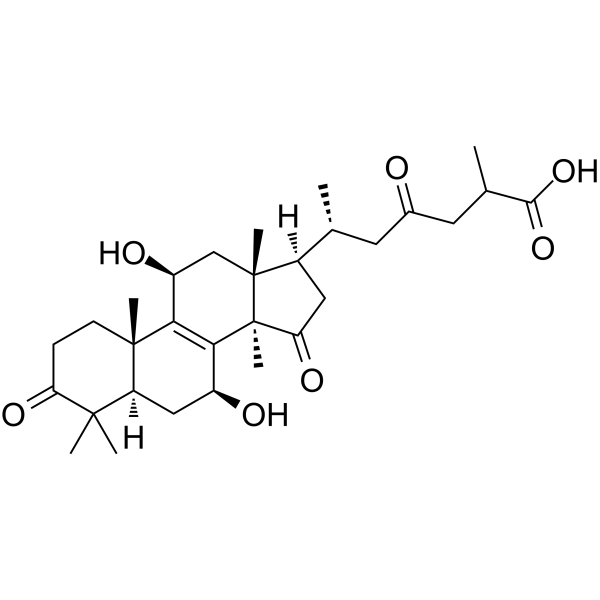 0 ImagesCat. No.: HY-N11639CAS No.: 1352033-73-8Ganoderic acid Df is a lanostane-type triterpenoid, that can be isolated from the fruiting body of Ganoderma lucidum. Ganoderic acid Df potently inhibits aldose reductase, with an IC50 of 22.8 ± 0.6 μM.
-
Salfredin A4
 0 ImagesCat. No.: HY-N14449CAS No.: 139542-54-4Salfredin A4 is an aldose reductase inhibitor.




